This is general information, not financial or tax advice. Per-mile rates and payment rules are set in your contract and change without notice. Always read your current agreement and check with your operator. HMRC rates are correct as of 2026 and subject to change.
What "mileage pay" actually means
Most courier contracts include a pence-per-mile element. On paper it looks simple: drive 300 miles, get paid £X per mile. In practice, what "miles driven" means is defined by the company, not your odometer, and each operator defines it differently.
The number on your pay statement is usually a planned distance — the route the system mapped before you left the depot, via its own algorithm. If you drove further because of a diversion, a failed delivery re-attempt, or a slightly different route, you typically absorb that difference. If the system mapped it shorter because it used straight-line estimates for part of the round, you absorb that too.
This is not a secret. It is written into the subcontractor agreements. What many drivers miss is that the gap accumulates across every shift, and a small per-shift shortfall can become a significant annual figure.
How Amazon, DHL, DPD and Evri calculate it
The specifics vary by contract tier, DSP, and year. These are the broad patterns based on publicly discussed terms. Your contract may differ — check yours.
Amazon (DSP / Amazon Flex)
Amazon Logistics drivers who work through a Delivery Service Partner (DSP) are employees of the DSP, not Amazon. The DSP sets your mileage rate against routes allocated by Amazon Logistics. Route distance is the planned distance calculated by Amazon's routing software. Return miles to depot are usually included in the plan, but the route from your home to the depot is your own cost.
Amazon Flex (block bookings, own vehicle) works differently: blocks are paid at a flat rate for the block, not per mile. Mileage as a cost is borne by the driver; you claim it as a business expense against your tax. If your block rate per mile driven falls below the HMRC approved amount (45p/mile up to 10,000 miles), you can claim the difference as Mileage Allowance Relief.
DHL Parcel (self-employed / owner-driver)
DHL Parcel UK's self-employed franchisee model pays on a combination of stops completed and mileage. Mileage is typically calculated from the delivery point list — the straight-line or planned-road distance between consecutive stops in the sequence assigned that day. Changes to the sequence (for example, a re-sort at the van because the manifested order does not match road layout) can mean your actual route is longer than the paid route.
DHL Parcel also uses a fuel component that may be adjusted by a quarterly fuel index, which partly offsets diesel cost changes but is not the same as paying you for extra miles driven.
DPD (owner-driver franchise)
DPD owner-drivers (ODs) typically receive a per-parcel rate and a separately stated mileage rate. The mileage is calculated by DPD's planning system against the franchise territory. The territory itself defines roughly how many miles the round is expected to cover. If the round grows (more parcels, more area) the territory should be renegotiated to reflect it — but in practice, drivers often cover extra miles on an unchanged rate while the territory review is pending.
DPD publishes minimum earnings and productivity targets. The mileage component is intended to cover fuel, not wear. Your actual fuel cost depends on the vehicle, load and driving style. Driving a 3.5T Luton on a rural DPD round at 18 mpg is a very different fuel equation from the rate modelled on a transit.
Evri (formerly Hermes, self-employed courier)
Evri couriers are self-employed and own their round. Pay is per parcel, and a mileage element is built into the parcel rate rather than stated separately. This makes it harder to see what the per-mile component is, because it varies by parcel count and round density. A dense urban round might earn the same total as a sparser semi-rural one, but the mileage driven is very different.
Because the per-parcel model bundles mileage, Evri drivers comparing their actual miles to a contracted rate have to work backwards from total pay. The HMRC self-employed simplified mileage rate (45p/mile) is useful as a reference: if your total Evri pay divided by your total miles is below 45p, you should be able to claim the shortfall as a deductible business cost.
Summary: what they share in common
| Company | Mileage basis | Home-to-depot | Diversions |
|---|---|---|---|
| Amazon DSP | Planned route (Amazon system) | Driver's cost | Not usually paid |
| Amazon Flex | Flat block rate (no per-mile) | Driver's cost | Driver's cost |
| DHL Parcel | Planned stop-to-stop distance | Driver's cost | Not usually paid |
| DPD | Territory-based planned route | Driver's cost | Not usually paid |
| Evri | Bundled into parcel rate | Driver's cost | Driver's cost |
Rates and methods change with contract updates. Always check your current agreement.
Why your actual miles and paid miles never quite match
Even when a company genuinely intends to pay you for the miles you drive, there are structural reasons the numbers diverge:
Planned vs actual routing
The system that builds your route uses historical maps, not live conditions. A road closure, a temporary traffic order, or a roadworks diversion that adds three miles to one stop adds up across a week of shifts. The plan does not update retroactively.
Sequencing changes you make at the van
Experienced drivers often re-sort their load to match road layout rather than the manifested order. That cuts driving time and helps customers — but your actual route is now different from the planned one that the mileage figure was built on. You may drive fewer total miles than planned (good for fuel, neutral for pay) or more (costs you money, no extra pay).
Failed deliveries and re-attempts
A parcel you cannot deliver because no one is home and there is nowhere safe to leave it may need a second attempt later in the shift or on a different day. Whether those extra miles appear in the plan depends on whether the system schedules the re-attempt as a new stop. Often it does not — the extra trip is absorbed.
Depot location vs your territory
Most contracts pay from depot to first stop and from last stop back to depot. If the depot is 20 miles from your territory because you took over someone else's round or the depot moved, those 40 dead miles each day are usually your cost unless your contract specifically states otherwise.
Round growth between territory reviews
Parcel volumes grow. A territory that covered 180 miles a day when you started covering it may now regularly hit 220. Until the territory is formally reviewed and the mileage rate or territory boundaries updated, you are doing extra miles at the old rate.
Vehicle differences
Mileage pay is rarely calibrated to your actual vehicle. A rate set assuming a 1.5T Transit Custom will not cover the cost of running a 3.5T curtainsider on the same round. Fuel cost per mile roughly doubles with a heavier vehicle doing similar work. The mileage rate stays the same.
The HMRC approved mileage rate and what it means for you
HMRC sets an Approved Mileage Allowance Payment (AMAP) rate. For cars and vans it is 45p per mile for the first 10,000 miles in a tax year, then 25p per mile above that.
The AMAP rate is not a minimum wage requirement — companies are free to pay less. But the tax treatment depends on it:
- If you are self-employed, you can deduct 45p/mile from profits as a simplified expense (up to 10,000 miles). If your company pays you, say, 22p/mile, you can claim the remaining 23p/mile as a deduction against the business income.
- If you are employed (PAYE) and your employer pays below the AMAP rate, you can claim Mileage Allowance Relief — the difference between AMAP and what you were actually paid — as a tax deduction, via Self Assessment or form P87.
To claim anything you need a mileage log: date, start point, destination, business purpose, miles. An app that records shift mileage automatically covers the minimum for most courier work.
This is general information. Your tax position depends on your employment status and other factors. Check with HMRC or a qualified accountant.
Mileage Pay Check in Rydealog
Rydealog's Mileage Pay Check is built for exactly this. You enter your contracted mileage rate once. Each shift, you record your start and end odometer readings (or the app can use GPS distance). At the end of the shift — and across the week — it shows you the difference between what you should have been paid and what your total mileage would earn at your rate.
If your DPD contract says 28p/mile and you drove 347 miles on a shift but your statement only reflects 312, the app surfaces that 35-mile gap: roughly £9.80 at that rate. Small per-shift, significant over a year.
The check does not connect to your operator's systems and does not know what they have paid you — you compare the app's figure to your actual pay statement. The point is to give you a number to bring to a query, not to make the claim for you.
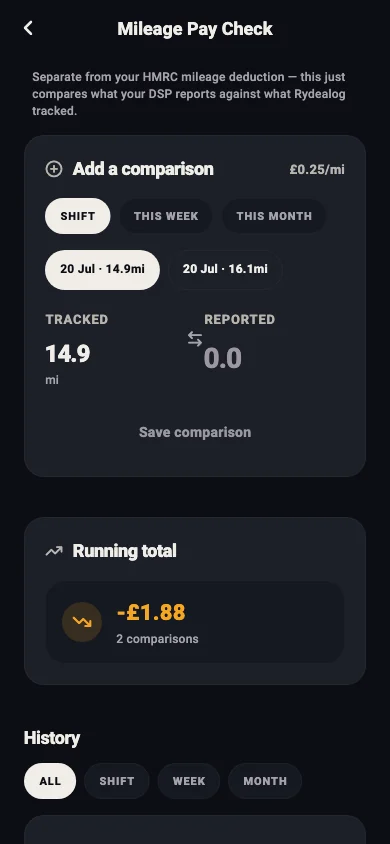

Mileage Pay Check is a Pro feature. The mileage tracker and shift log are free.
How to use Mileage Pay Check step by step
- Open Rydealog and go to the Money tab, then Mileage Pay Check
- Enter your contracted pence-per-mile rate (check your agreement or last pay statement)
- At the start of each shift, note the odometer or let the app start a GPS track
- At the end of the shift, enter the end reading — the app logs the distance
- When your pay statement arrives, compare the "expected pay" total in the app to the mileage line on your statement
- If there is a consistent gap, export the mileage log and raise a query with your operator or depot manager
Keep exports of your mileage log alongside pay statements. If you are self-employed, your accountant will also need them at year end for your self-assessment mileage deduction.
FAQs
How do delivery companies calculate mileage pay?
Most use a planned or routed distance, not your actual odometer. The route is calculated from the depot to the first stop and between subsequent stops. Return miles, traffic diversions and any distance from your home to the depot are often excluded. The method varies by company.
Why is my mileage pay less than I expected?
Common reasons: the company pays from depot only, not from your home. The planned route is shorter than what you drove due to road closures or diversion. Failed deliveries may not add to the paid distance. Some contracts use a fixed planned distance that does not update when routes change. Tracking your actual miles and comparing to your statement is the only reliable way to spot a gap.
What is the HMRC approved mileage rate for delivery drivers?
HMRC's AMAP rate for cars and vans is 45p per mile for the first 10,000 miles in a tax year, then 25p above that. If your operator pays less, self-employed drivers can deduct the shortfall as a business expense; employed drivers can claim Mileage Allowance Relief. This is general information — speak to an accountant for advice on your situation.
How can I check if I am being paid correctly for mileage?
Record your odometer at the start and end of every shift. Multiply total miles by your contracted rate. Compare to your statement. Rydealog's Mileage Pay Check does this automatically and flags any shortfall shift by shift.
Can I claim tax relief on mileage that my company underpays?
Self-employed drivers can deduct business mileage against profits at the simplified rate or actual costs. PAYE employees paid below the AMAP rate can claim Mileage Allowance Relief via Self Assessment or form P87. Keep a log of every business journey. This is general information, not tax advice — check with HMRC or a qualified accountant.
Sources
Last checked 2026-09. Primary sources only. Rates and guidance can change.
More from Rydealog
Track every mile: mileage tracker guide. What you can claim at year end: self-employed courier expenses. What a round actually pays after fuel and van rent: round pay calculator. Know the stop before you get there: delivery stop tips. Rydealog homepage.
Free on iPhone. Android coming soon.