This is general information, not tax advice. It is for sole traders. Limited companies are different. What you can claim depends on your facts and whether you use mileage or actual costs. Figures below are what GOV.UK stated when we last checked. Check HMRC guidance or ask an accountant before you file.
Mileage or actual van costs — not both
GOV.UK simplified expenses lets you claim a flat rate per business mile instead of the actual costs of buying and running the vehicle (insurance, repairs, servicing, fuel). You can use it for cars, goods vehicles (vans) and motorcycles. You cannot use it for a vehicle you have already claimed capital allowances on, or already put through as an expense.
| Vehicle | 2026–27 | Before 6 April 2026 |
|---|---|---|
| Cars and vans, first 10,000 miles | 55p | 45p |
| Cars and vans, after 10,000 miles | 25p | 25p |
| Motorcycles | 24p | 24p |
GOV.UK’s example: 11,000 business miles in 2026–27 is 10,000 × 55p plus 1,000 × 25p = £5,750. Once you use the flat rate for a vehicle, you must keep using it for as long as that vehicle is in the business. You do not have to use it for every vehicle. Parking can sit on top of the mileage rate. Fuel cannot.
Some pages still quote 45p. That was the rate before 6 April 2026. Employee “approved mileage” rates are a different scheme; they currently match these numbers, but this page is about self-employed simplified expenses.
What you can usually claim
Allowable expenses are costs of the business, not money taken for personal use. If you use something for both, only the business slice counts. If you take the £1,000 trading allowance, you cannot claim these expenses as well.
| Cost | Claim? | Notes |
|---|---|---|
| Fuel | Depends | Yes if you claim actual running costs. No if you use the mileage rate for that van — fuel is inside the rate. |
| Van rent or lease | Depends | Hire charges are listed as an actual travel cost. If you use mileage for that vehicle, do not also put the hire through as a running cost. Check HMRC if you hire a different van each week. |
| Insurance, including hire-and-reward | Depends | Vehicle insurance is an actual cost. A hire-and-reward policy for paid delivery is still insurance for the work. Not if that van is on the mileage rate. Only the business slice if the policy covers private use too. |
| Phone | Split | Office costs include phone bills. GOV.UK’s example: £200 bill, £70 of business calls — claim £70. Split fairly if you use the same phone at home. |
| Parking | Yes | Parking is an allowable travel cost, and GOV.UK says you can claim it on top of mileage. Not fines or penalty charges. Not the commute if HMRC treats it as home-to-work. |
| PPE and hi-vis | Usually | Uniforms and protective clothing needed for the work. Everyday clothes, even if you only wear them on the round, are not allowable. |
| Software subscriptions | Maybe | Office and admin costs of the business. Used wholly for the delivery work, it may be allowable. Used for everything on the phone, only a fair split. If you are not sure, ask HMRC or an accountant. |
| Trolley or sack truck | Yes | Equipment you buy and keep for the business. On cash basis (the default from 2024–25) that is usually an allowable expense. Traditional accounting may treat it as a capital allowance instead. |
Also on GOV.UK’s travel list: repairs, servicing, vehicle tax, breakdown cover. Not: non-business miles, fines, or travel between home and work.
The £1,000 trading allowance
You can get up to £1,000 a year tax-free on trading income. If gross trading income is £1,000 or less you may not have to tell HMRC. If it is more than £1,000 you must register for Self Assessment by 5 October after the tax year. You can use the allowance instead of expenses — you cannot do both. On a full multi-drop year, actual expenses almost always beat £1,000. Keep records of the income either way.
Self Assessment deadline
The tax year runs 6 April to 5 April. GOV.UK deadlines for the 2025–26 year (ended 5 April 2026):
- Paper return: 31 October 2026, 11:59pm
- Online return: 31 January 2027, 11:59pm
- Pay the tax: 31 January 2027, 11:59pm
- Tell HMRC you need a return, if you are new: 5 October
There can be a second payment on 31 July (payments on account). Miss 31 January and you get a penalty. Check HMRC guidance or ask an accountant if your dates differ.
Making Tax Digital for Income Tax
Qualifying income is your gross self-employment and property income — turnover before expenses. PAYE wages do not count. GOV.UK:
- Over £50,000 in 2024–25 — use MTD from 6 April 2026
- Over £30,000 in 2025–26 — from 6 April 2027
- Over £20,000 in 2026–27 — from 6 April 2028
That means digital records, compatible software, and quarterly updates, then still a tax return by the following 31 January. HMRC should write if you are over the line; it is still your job to check. Use their tool if you are unsure. Some people are exempt (for example if they are digitally excluded).
Records to keep
You do not send the shoebox with the return. You keep it so you can complete the return and show HMRC if they ask. Self-employed records must be kept for at least 5 years after the 31 January deadline for that tax year.
- All sales and income (self-bills, depot statements, bank in)
- All business expenses, with receipts or statements
- Business miles, if you use the mileage rate
- How you split the phone and any mixed-use costs
- Van hire invoices, insurance (including hire-and-reward), fuel
- Parking — not the PCN
- Bank statements that match the round
See what a shift paid after van rent and fuel with the round pay calculator. That page is not a tax return.
Miles, hours and costs in Rydealog
Rydealog logs miles, hours and costs against the shift they belong to, so January is not a hunt through camera roll and a notebook. It is not Making Tax Digital software and it does not file your return.
Use Rydealog wholly and exclusively for your self-employed delivery business? You may be able to claim 100% of the subscription as an allowable software expense. This reduces taxable profit rather than refunding the full price. Eligibility depends on your circumstances and accounting method; check current HMRC guidance or ask a tax professional.
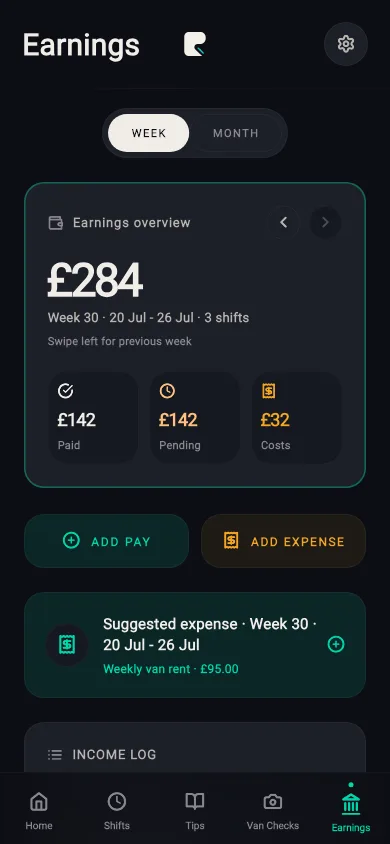

Track miles, hours and costs in Rydealog. Free to start; earnings and costs are on Pro.
FAQs
What mileage rate can self-employed couriers claim?
For the 2026 to 2027 tax year, simplified expenses are 55p a mile for the first 10,000 business miles in a car or goods vehicle (van), then 25p. Before 6 April 2026 the first-10,000 rate was 45p. Motorcycles are 24p. This is general information, not tax advice.
Can I claim fuel and the mileage rate?
No. You choose a mileage flat rate or the actual costs of running that vehicle — not both. The mileage rate stands in for fuel, insurance, repairs and servicing. You can still claim parking on top. Check HMRC guidance or ask an accountant.
What is the £1,000 trading allowance?
It is a tax-free allowance of up to £1,000 a year on trading income. If you use it, you cannot also deduct expenses. If your gross trading income is more than £1,000 you must register for Self Assessment. Most multi-drop drivers will claim actual expenses instead.
When is Self Assessment due, and who needs Making Tax Digital?
HMRC must receive your online tax return and any tax you owe by 31 January after the tax year. For 2025 to 2026 that is 31 January 2027. Making Tax Digital for Income Tax is based on qualifying income (gross self-employment and property, before expenses): over £50,000 in 2024 to 2025 from 6 April 2026; over £30,000 in 2025 to 2026 from 6 April 2027; over £20,000 in 2026 to 2027 from 6 April 2028.
Can I claim a Rydealog subscription?
Use Rydealog wholly and exclusively for your self-employed delivery business? You may be able to claim 100% of the subscription as an allowable software expense. This reduces taxable profit rather than refunding the full price. Eligibility depends on your circumstances and accounting method; check current HMRC guidance or ask a tax professional.
Sources
Last checked 2026-09. GOV.UK only. Guidance can change. Check HMRC guidance or ask an accountant.
- Simplified expenses — vehicles
- Expenses if you’re self-employed
- Car, van and travel expenses
- Clothing expenses
- Tax-free allowances on property and trading income
- Self Assessment deadlines
- Find out if and when you need to use Making Tax Digital for Income Tax
- Work out your qualifying income for Making Tax Digital
- Business records if you’re self-employed
- What records to keep
- How long to keep your records
- Travel — mileage and fuel rates and allowances (employee approved mileage; currently 55p / 25p for cars and vans)
More from Rydealog
What the round paid after van rent and fuel: round pay calculator. Photo the van before you start: courier van-check checklist. Charged for a missing parcel: what to do. Stop tips, mileage and PODs: Rydealog homepage.
Free on iPhone. Android coming soon.