A £54 block for 3 hours reads as £18 an hour. Add 40 minutes to get to the station and back and 60 miles in your own car, and the number is very different. Type in a real block, or a whole day of blocks, and see for yourself.
Nothing you type is saved or sent anywhere.
Work it out
Per hour
Enter the block pay and hours to see what it really paid.
Before tax and National Insurance. You pay those yourself as a self-employed driver.
How to read the numbers
- After fuel is the cash left in your pocket today.
- After the full cost of the car also counts tyres, servicing, insurance and the car losing value. They do not show up on the day, but every mile adds to them. HMRC's 55p a mile is a rough guide to that full cost, so this is the honest number.
- The minimum wage (National Living Wage, £12.71 an hour from April 2026) is the line to beat. An employee on it also gets holiday pay and has tax taken for them. You do not, so a Flex block should pay comfortably more to be worth it.
What makes a block worth taking
- Short distance to the station. Twenty minutes each way on a 3-hour block cuts your hourly rate by 18%, and nobody shows you that.
- Surge pay. Compare the surge price per hour door to door, not the base rate.
- Tips on grocery and same-day blocks. Put your real average in the tips box, not your best day.
- Finishing early. A 4-hour block done in 3 pays more per hour. Use the hours you actually worked.
Tax on Amazon Flex
Flex drivers in the UK are self-employed. You register for Self Assessment and pay income tax and Class 4 NI on profit. The good news: the miles you drive reduce that profit, at 55p a mile for the first 10,000 from April 2026 (45p before). Work out what to set aside with the courier tax calculator.
Track every block in Rydealog
Rydealog logs each shift's hours, miles and pay as you drive, so you can see which blocks and stations actually pay. The mileage log is ready for your tax return, and the AI pay check reads your weekly Flex earnings screenshot and checks it against your shifts.
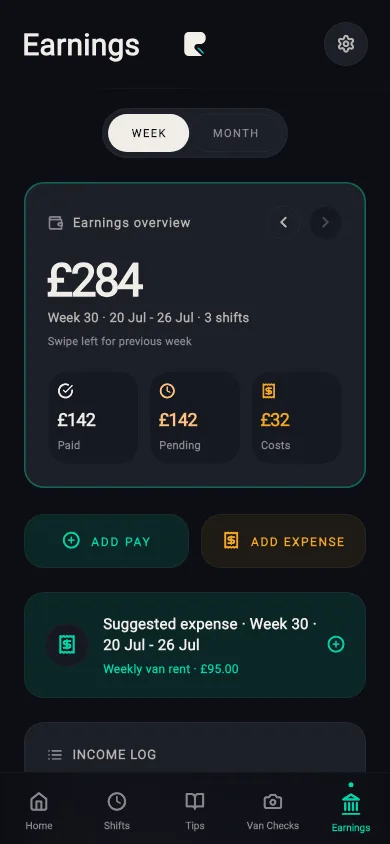


Track this automatically in Rydealog. Free on iPhone and Android.
FAQs
Is Amazon Flex worth it in the UK?
It depends on the block. Take the block pay and tips, subtract the cost of the miles, and divide by every hour you spent, including driving to the station and back. If what is left per hour is under the National Living Wage (£12.71 from April 2026), that block paid less than a minimum-wage job, before you have paid your own tax and NI.
Is Amazon Flex worth it after fuel?
Fuel is only part of the cost. Tyres, servicing, insurance and the car losing value all grow with the miles. HMRC's 55p a mile is a rough guide to the full cost of running a car, so this calculator shows your hourly rate both after fuel and after 55p a mile.
Do I pay tax on Amazon Flex?
Yes. Amazon Flex drivers in the UK are self-employed, so you register for Self Assessment and pay income tax and Class 4 National Insurance on your profit. The mileage you drive for Flex reduces that profit. Use the courier tax calculator to estimate what to set aside.
Should I count the drive to the delivery station?
Yes. The block starts at the station, but your time and miles start at home. Put the whole trip into hours and miles, or the calculator will flatter the block.
Sources
Checked 2026-11 on GOV.UK: National Living Wage (£12.71 from 1 April 2026) and simplified expenses for vehicles (55p a mile). Fuel uses the UK gallon, 4.54609 litres. Rydealog is not affiliated with or endorsed by Amazon. Amazon Flex is a trademark of Amazon.com, Inc. or its affiliates.
More from Rydealog
What to set aside for HMRC: courier tax calculator. Paid per parcel: Evri driver pay calculator. A multi-drop day with van rent: round pay calculator. What you can claim: self-employed courier expenses. Keeping the miles: mileage tracker.